Man has an idea that there can be only one religion, that there can
be only one Prophet, and that there can be only one Incarnation; but
that idea is not true. By studying the lives of all these great
Messengers, we find that each, as it were, was destined to play a part,
and a part only; that the harmony consists in the sum total and not in
one note. As in the life of races — no race is born to alone enjoy the
world. None dare say no. Each race has a part to play in this divine
harmony of nations. Each race has its mission to perform, its duty to
fulfil. The sum total is the great harmony.
Showing posts with label Swami Vivekananda Speeches. Show all posts
Quotes by Indian Monk Swami Vivekananda
![]() |
| Swami Vivekananda Quotes |
If you are really my children, you will fear nothing, stop at nothing. You will be like lions. We must rouse India and the whole world. No cowardice. I will take no nay.Do you understand?
- Swami Vivekananda Quotes
![]() | ||
![]() |
| Swami Vivekananda |
![]() |
| Swami Vivekananda |
![]() |
| Swami Vivekananda |
![]() |
| Swami Vivekananda |
My collection of Swami Vivekananda Quotes
for Proud Indians Living in India Or Abroad.
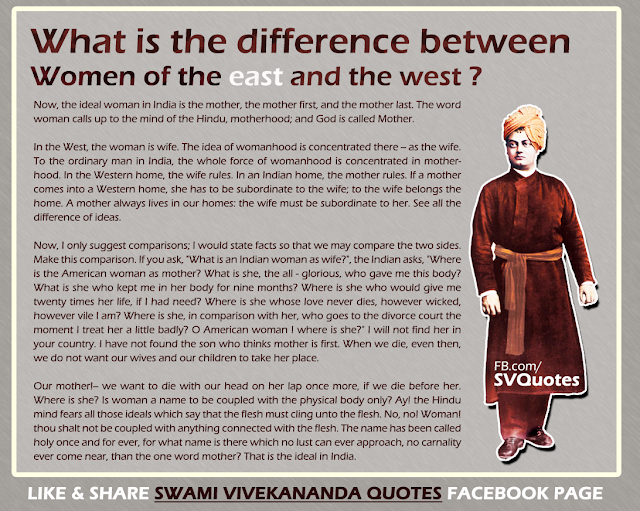
What is the difference between Indian women and Women of the West ?
Now, the ideal woman in India is the mother, the mother first, and the
mother last. The word woman calls up to the mind of the Hindu,
motherhood; and God is called Mother.
In the West, the woman is wife. The idea of womanhood is concentrated there -- as the wife. To the ordinary man in India, the whole force of womanhood is concentrated in motherhood. In the Western home, the wife rules. In an Indian home, the mother rules. If a mother comes into a Western home, she has to be subordinate to the wife; to the wife belongs the home. A mother always lives in our homes: the wife must be subordinate to her. See all the difference of ideas.
Now, I only suggest comparisons; I would state facts so that we may compare the two sides. Make this comparison. If you ask, "What is an Indian woman as wife?", the Indian asks, "Where is the American woman as mother? What is she, the all - glorious, who gave me this body? What is she who kept me in her body for nine months? Where is she who would give me twenty times her life, if I had need? Where is she whose love never dies, however wicked, however vile I am? Where is she, in comparison with her, who goes to the divorce court the moment I treat her a little badly? O American woman ! where is she?" I will not find her in your country. I have not found the son who thinks mother is first. When we die, even then, we do not want our wives and our children to take her place. Our mother!-- we want to die with our head on her lap once more, if we die before her. Where is she? Is woman a name to be coupled with the physical body only? Ay! the Hindu mind fears all those ideals which say that the flesh must cling unto the flesh. No, no! Woman! thou shalt not be coupled with anything connected with the flesh. The name has been called holy once and for ever, for what name is there which no lust can ever approach, no carnality ever come near, than the one word mother? That is the ideal in India. (Excerpts from a talk 'WOMEN OF INDIA'

The idea women, in India, is the mother, the mother first and the mother
last. The word woman calls up to the mind of the Hindu, Motherhood; and
God is called Mother.
CW: Vol.8: Lectures and discourses: Women of India (p.57)
Swami Vivekananda - Youth is the Future of India!
Born to an aristocratic
Bengali family of Calcutta, Swami Vivekananda is considered as the Youth Icon
of India. Known as Narendranath Datta in his pre-monastic life, he was the son
of Vishwanath Datta, a successful attorney with interests in a wide range of
subjects, and his mother, Bhuvaneshwari Devi, was gifted with deep devotion,
strong character and other qualities. A talented boy, Narendra excelled in the
fields of gymnastics and music, besides his regular studies. He acquired a vast
knowledge of different subjects, especially Western philosophy and history by
the time he graduated from Calcutta University. He was an important person to
introduce the Indian philosophies of Vedanta and Yoga to the Western world and
is credited with raising interfaith awareness, bringing Hinduism to the status
of a major religion of the world during the late 19th century. He was a major
power for revival of Hinduism in India, and contributed to the concept of
nationalism in the country. He was influenced by his guru, Ramakrishna, from
whom he learnt that all living beings were an embodiment of the divine self;
therefore, service to God could be rendered by service to mankind and later he
established the Ramakrishna Math and the Ramakrishna Mission.
![]() |
| Swami Vivekananda Quotes on Youth |

Swami
Vivekananda believed that youth is the most precious time of life and under-utilizing the potential they possess is loss for the
individuals as well as for the nation. He stated that highest value of youth
period is immeasurable and incommunicable as it is the most valuable phase of
life and the way it is utilize will decide the personality of coming years that
lie ahead. He also stated that the happiness, honor, success and good name, all
is dependent on way in which one lives during his youthful days. The youthful
days are of utmost interest and he provides an anecdote in which he states that
youthful days are just like the wet clay in the hands of potter and the potter
with his skills moulds it. Similarly, the youth as well needs to be molded to
make them better human beings. Hence, he rightly stated that “youth is the
future of our country”.
Swamiji also stated that in a huge country like India, where numerous cultures coincides, conceived of life in four stages, namely preliminary stage, development stage, flowering or blossoming stage and the culminating fruitful stage. Youthful stage is that stage of preliminary preparations for right and successful living. Herein is its supreme value and great importance. He explained the whole concept, making the people of the country understand the importance of Youth and believe in their capability to conquer the world. He became an inspiration for the young generation of the country and his birthday has been declared as “National Youth Day” by the Indian Government. Swami Vivekananda has always been considered as a youth icon and his contribution towards bringing India into the limelight is worth mentioning.

Swamiji also stated that in a huge country like India, where numerous cultures coincides, conceived of life in four stages, namely preliminary stage, development stage, flowering or blossoming stage and the culminating fruitful stage. Youthful stage is that stage of preliminary preparations for right and successful living. Herein is its supreme value and great importance. He explained the whole concept, making the people of the country understand the importance of Youth and believe in their capability to conquer the world. He became an inspiration for the young generation of the country and his birthday has been declared as “National Youth Day” by the Indian Government. Swami Vivekananda has always been considered as a youth icon and his contribution towards bringing India into the limelight is worth mentioning.

![]() |
| Swami Vivekananda |

Famous Quotes by Swami Vivekananda
Collection of Famous quotes by Swami Vivekananda
![]() |
| Famous Quotes by Swami Vivekananda |
![]() |
| Famous Quotes by Swami Vivekananda |
![]() |
| Famous Quotes by Swami Vivekananda |
![]() |
| Famous Quotes by Swami Vivekananda |
![]() |
| Famous Quotes by Swami Vivekananda |
![]() |
| Famous Quotes by Swami Vivekananda |
![]() |
| Famous Quotes by Swami Vivekananda |
Swami Vivekananda's Speech in Chicago at the World's Parliament of Religions
11th September, 1893
It fills my heart with joy unspeakable to rise in response to the warm and cordial welcome which you have given us. I thank you in the name of the most ancient order of monks in the world; I thank you in the name of the mother of religions; and I thank you in the name of millions and millions of Hindu people of all classes and sects.
My thanks, also, to some of the speakers on this platform who, referring to the delegates from the Orient, have told you that these men from far-off nations may well claim the honour of bearing to different lands the idea of toleration. I am proud to belong to a religion which has taught the world both tolerance and universal acceptance. We believe not only in universal toleration, but we accept all religions as true. I am proud to belong to a nation which has sheltered the persecuted and the refugees of all religions and all nations of the earth. I am proud to tell you that we have gathered in our bosom the purest remnant of the Israelites, who came to Southern India and took refuge with us in the very year in which their holy temple was shattered to pieces by Roman tyranny. I am proud to belong to the religion which has sheltered and is still fostering the remnant of the grand Zoroastriannation. I will quote to you, brethren, a few lines from a hymn which I remember to have repeated from my earliest boyhood, which is every day repeated by millions of human beings: "As the different streams having their sources in different places all mingle their water in the sea, so, O Lord, the different paths which men take through different tendencies, various though they appear, crooked or straight, all lead to Thee."
The present convention, which is one of the most august assemblies ever held, is in itself a vindication, a declaration to the world of the wonderful doctrine preached in the Gita: "Whosoever comes to Me, through whatsoever form, I reach him; all men are struggling through paths which in the end lead to me." Sectarianism, bigotry, and its horrible descendant, fanaticism, have long possessed this beautiful earth. They have filled the earth with violence, drenched it often and often with human blood, destroyed civilisation and sent whole nations to despair. Had it not been for these horrible demons, human society would be far more advanced than it is now. But their time is come; and I fervently hope that the bell that tolled this morning in honour of this convention may be the death - knell of all fanaticism, of all persecutions with the sword or with the pen, and of all uncharitable feelings between persons wending their way to the same goal.
Sisters and Brothers of America,
It fills my heart with joy unspeakable to rise in response to the warm and cordial welcome which you have given us. I thank you in the name of the most ancient order of monks in the world; I thank you in the name of the mother of religions; and I thank you in the name of millions and millions of Hindu people of all classes and sects.

My thanks, also, to some of the speakers on this platform who, referring to the delegates from the Orient, have told you that these men from far-off nations may well claim the honour of bearing to different lands the idea of toleration. I am proud to belong to a religion which has taught the world both tolerance and universal acceptance. We believe not only in universal toleration, but we accept all religions as true. I am proud to belong to a nation which has sheltered the persecuted and the refugees of all religions and all nations of the earth. I am proud to tell you that we have gathered in our bosom the purest remnant of the Israelites, who came to Southern India and took refuge with us in the very year in which their holy temple was shattered to pieces by Roman tyranny. I am proud to belong to the religion which has sheltered and is still fostering the remnant of the grand Zoroastriannation. I will quote to you, brethren, a few lines from a hymn which I remember to have repeated from my earliest boyhood, which is every day repeated by millions of human beings: "As the different streams having their sources in different places all mingle their water in the sea, so, O Lord, the different paths which men take through different tendencies, various though they appear, crooked or straight, all lead to Thee."
The present convention, which is one of the most august assemblies ever held, is in itself a vindication, a declaration to the world of the wonderful doctrine preached in the Gita: "Whosoever comes to Me, through whatsoever form, I reach him; all men are struggling through paths which in the end lead to me." Sectarianism, bigotry, and its horrible descendant, fanaticism, have long possessed this beautiful earth. They have filled the earth with violence, drenched it often and often with human blood, destroyed civilisation and sent whole nations to despair. Had it not been for these horrible demons, human society would be far more advanced than it is now. But their time is come; and I fervently hope that the bell that tolled this morning in honour of this convention may be the death - knell of all fanaticism, of all persecutions with the sword or with the pen, and of all uncharitable feelings between persons wending their way to the same goal.
Subscribe to:
Posts (Atom)